
Washington Square News: Off the Radar: ‘Golden Gate Girls’ highlights forgotten film history
By Ellie DaSilva
The story of Esther Eng, a lesbian Asian American filmmaker who worked in the 1940s, comes to light in this inspiring documentary.
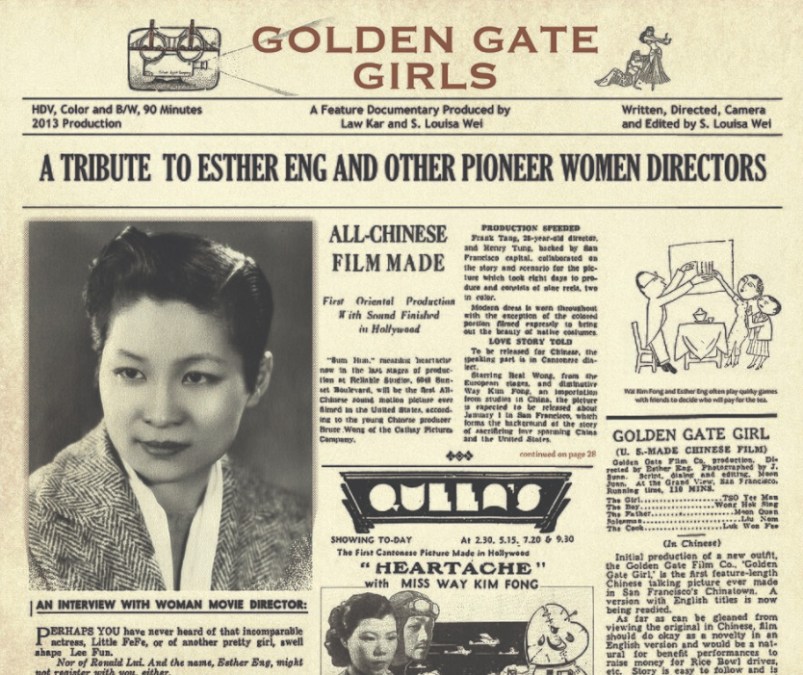
Men have always dominated the film industry. Thankfully, archival work has revealed influential women’s stories that have been lost or shut away. The 2013 documentary “Golden Gate Girls” shines a spotlight on Ng Kam-ha, or Esther Eng, a revolutionary lesbian and Asian American silent film director.
Born in 1914, Eng grew up in San Francisco, California. She quickly fell in love with film and worked at the box office of the historic Mandarin Theatre. After working with her father at his Kwong Ngai Talking Pictures Company, Eng founded her own production company, Silver Light, in 1948, where she produced 10 feature films in both Hollywood and Hong Kong. Her filmography consisted of romance and war films relevant to the time period, such as “Heartaches” (1936), which tells the tragic story of a romance between a young opera star and an aviation student.
Despite being an open lesbian, the authority and respect Eng commanded earned her the nickname Brother Ha among colleagues. No one questioned that she wore pants and collared shirts instead of dresses.
“Golden Gate Girls” comes to life through stories rediscovered by Chinese filmmaker S. Louisa Wei. In 2009, valet shop owner Jack Dooley found a box of 600 photographs in a dumpster near San Francisco International Airport. He sold it to pharmacist and movie lover James Wong, who allowed Wei to scan the photographs and discover that the woman featured was Eng. Through interviews with old colleagues, Wei retraces Eng’s steps and pieces together her life story. We come to learn about Eng’s influence in a time of gender inequality, as she stood among her male colleagues without acknowledgement of difference.
“Golden Gate Girls” is available to stream on Kanopy.
To read the entire article: https://nyunews.com/arts/film/otr/2025/11/24/golden-gate-girls/
Photo credit: Louisa Wei, CC BY-SA 4.0, via Wikimedia Commons