
Newsweek: From Iron Rails to AI, Asian Americans Built a Nation
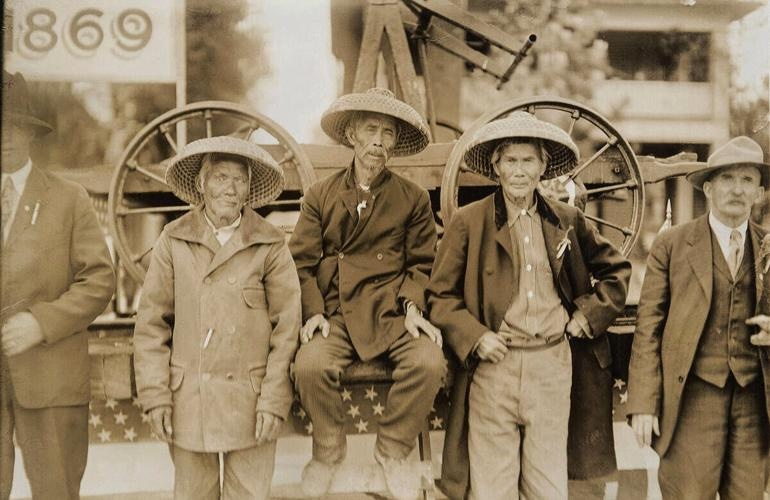
Three elderly Chinese railroad workers photographed next to a parade float celebrating the anniversary of the Transcontinental Railroad, 1919. Taken on 10 May 1919.
By
As America prepares for its 250th birthday in 2026, the “America250” commemoration invites us to re-examine our national story. It’s a call to move beyond simple celebration to a more honest, inclusive understanding of who built this country and who is building its future. No narrative better captures this continuity—and this national imperative—than the arc that stretches from the Chinese laborers who laid the Transcontinental Railroad to the Asian American pioneers shaping the artificial intelligence revolution today. They are bookends of American progress, connected by a legacy of foundational labor, profound contribution and a painful struggle for recognition.
More than 150 years ago, against the brutal granite of the Sierra Nevada, a workforce of 12,000 to 20,000 Chinese immigrants performed the impossible. They hung in baskets to plant dynamite, carved tunnels through mountains and laid the tracks that would bind a continent. Comprising roughly 80 percent of the Central Pacific Railroad’s workforce, they laid the groundwork for the United States to become a unified industrial powerhouse. The Transcontinental Railroad was the AI of its day—a breathtaking, risky technology that promised to reshape commerce, communication and national identity.
Yet, upon its completion in 1869, the iconic “Champagne Photo” at Promontory Summit, Utah, contained not a single Chinese face. This erasure was a prelude to the legal and cultural exclusion that followed, epitomized by the 1882 Chinese Exclusion Act. Their labor was essential, but their humanity and citizenship were denied. These indispensable builders were relegated to the shadows of the national myth.
To read the entire article: https://www.newsweek.com/from-iron-rails-to-ai-asian-americans-built-a-nation-opinion-11442661
Photo credit: San Francisco Public Library, Public domain, via Wikimedia Commons