
AALDEF Report: Chinatown Displacement in Boston, New York City, and Philadelphia
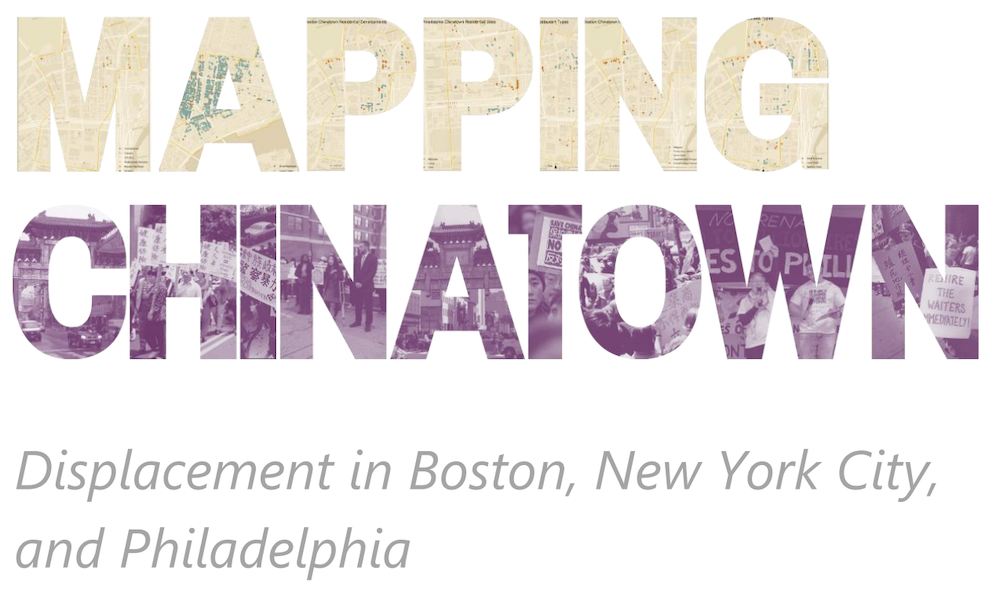
Below are excerpts from The Asian American Legal Defense and Education Fund’s report on Chinatown displacement in Boston, New York City, and Philadelphia.
EXECUTIVE SUMMARY
Chinatowns, like many communities of color, were born of struggle and now serve as safe havens and spaces of resistance. Their continued survival, in the face of decades of discrimination and targeting, make Chinatowns more than just neighborhoods—these communities can serve as barometers for the Asian immigrant experience. Especially at this moment, neighborhoods that have long helped immigrants find their place and community are more important than ever. When Chinatowns thrive, we know that Asian elders are receiving healthcare, workers can find a steady job, and residents with limited English proficiency can access social services and religious fellowship—usually through mutual aid networks built up over decades.
When Chinatowns decline, immigrants must find new social and support networks, often in more dispersed and sometimes inaccessible suburbs. Though appearing to have natural ebbs and flows, Chinatowns—and all neighborhoods—are shaped through zoning and planning decisions that drive land use. Zoning helps determine who lives in a neighborhood, what businesses predominate, and who flourishes.
This comprehensive land use report by the Asian American Legal Defense and Education Fund provides a critical and timely update on three swiftly changing neighborhoods across the Northeast, the Chinatowns of Boston, Manhattan, and Philadelphia. This work builds on AALDEF’s seminal report from 2013, which was the first comprehensive multi-city land use survey of these three Chinatowns
Key Findings
- In Boston and Manhattan’s Chinatowns, the Asian population itself decreased over the last decade by over 20%.
o Boston Chinatown’s Asian population dropped from roughly 5,800 to 4,500, a 3% decrease in share.
o Manhattan Chinatown’s Asian population decreased from roughly 52,000 to 41,000, resulting in an 11% decrease in share—nearly 4 times the rate of Asian population loss in the prior decade. - The number of Asian people living in Philadelphia’s Chinatown roughly stayed the same (at around 2,400 people), but given an influx of white residents, the share of Asian residents dropped by more than 13%.
- In Manhattan and Philadelphia, the overall population of Chinatown grew primarily due to an increase of non-Asian residents.
o White and Black residents in New York’s Chinatown each increased by 31% while the number of Asian residents decreased by 22%.
o In Philadelphia, the number of white residents grew by 77% and Hispanic residents increased by 35%, while the Asian population remained the same. As a result, while the neighborhood’s population increased by 15% overall, the Asian share of the population fell from 42% to 36%. - In Boston, Chinatown’s total population and Asian population decreased.
o In a reversal from the prior decade, the white population decreased more than Asian residents (27% compared to 23%), lowering the white share of the population by over 10%
The Asian American Legal Defense and Education Fund (AALDEF) was founded in 1974 to protect and promote the civil rights of Asian Americans. AALDEF serves diverse Asian communities around the country in solidarity with each other, communities of color, and marginalized groups. Community lawyering is at the heart of AALDEF’s work, which combines litigation, advocacy, education, and organizing to secure human rights for all people.
To read the entire report: https://cdn.sanity.io/files/iroghafc/production/7e834bfbb630c91eade349dcfd0ac6953924c7d6.pdf